Fundamental research needs time, patience and freedom
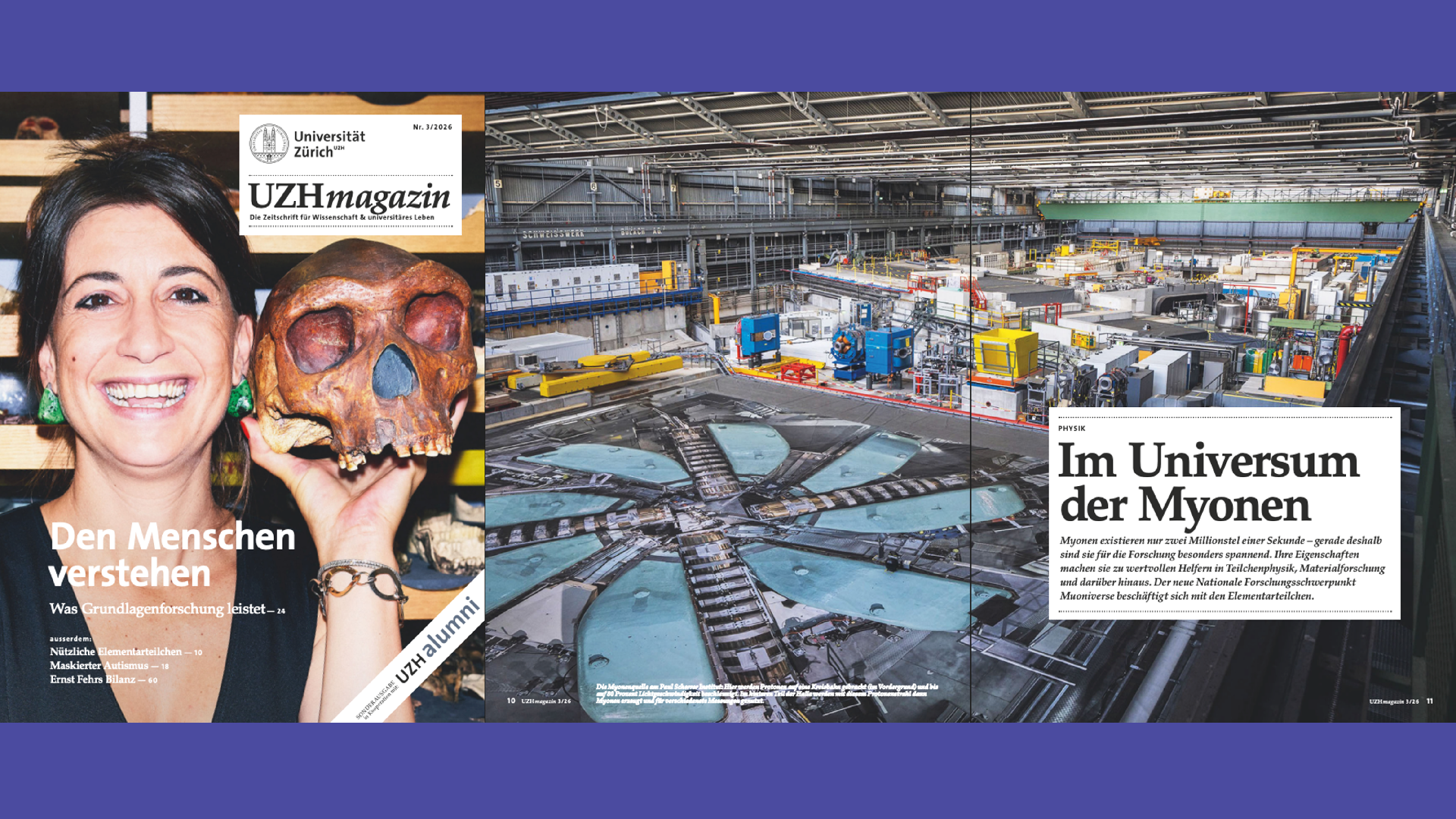
The latest issue of UZH Magazin — published by the University of Zurich — asks what fundamental research achieves. And its article on NCCR Muoniverse shows what that can look like in practice.
As Elisabeth Stark, Vice President Research at UZH, and statistician Servan L. Grüninger argue in the issue, fundamental research lays the foundation on which later innovation builds. The neural networks behind today's AI, for instance, go back to the 1940s.
Muoniverse builds on such a foundation and explores new directions. Swiss muon research leads internationally in particle physics and materials research, as our Co-Director Marc Janoschek explains. Muons, elementary particles that decay after only about two microseconds, already reveal the magnetic states of superconductors and 2D materials, and put the Standard Model to the test.
On this basis more than 30 research groups from 14 institutions across Switzerland, joined by teams from Germany, Italy and Japan, can now collaboratively grow the field into areas such as snow research and cultural heritage. The potential reaches from next-generation microelectronics to climate processes.
The NCCR format — with funding of up to twelve years — makes this possible. It offers much of what the issue's editorial names as essential for fundamental research: time, patience and freedom.
Read the article "Im Universum der Myonen" (in German, page 10):
https://issuu.com/uzhch/docs/uzh_magazin_3_26?fr=sMTdhOTkzMzI0OTk